13:05 ▪
4
min read ▪ by
The financial market is going through a period of strong turbulence. International tensions are indeed shaking the global economy. Currently, Bitcoin is experiencing significant volatility. Analysts observe that macroeconomics is now driving the course of this digital currency. As a result, technical fundamentals matter much less today. Instead, investors are keeping a close eye on global political decisions. These external factors ultimately determine the overall trend across the sector.
In short
- Geopolitics take control of markets: tensions in the Middle East, soaring oil prices and falling stock indexes weigh heavily on Bitcoin.
- Rising oil is fueling inflation and pushing the Fed to maintain tight monetary policy, reducing liquidity and slowing the momentum of bitcoin and risk assets.
- Institutional withdrawal: despite some recent inflows, mainstream investors remain cautious, increasing volatility and weakening the entire crypto market.
Geopolitical Tensions: Impact on Bitcoin Price
Recent attacks in the Middle East are worrying traditional markets. First, the price of Bitcoin fell below $65,000 this weekend. After that, buyers quickly raised the price back up to $67,000. However, the Strait of Hormuz remains completely closed to commercial ships.
Algorithmic trading firm Wintermute, in an article published on X, estimates that this naval blockade is prolonging the current international crisis. The airspace over the Persian Gulf region is subject to strict restrictions.
On the one hand, some political representatives hope for a very quick solution. However, other officials predicted a much longer conflict. Moreover, traditional finance reacts strongly to these unexpected events. According to reports, a barrel of oil gains 9% almost instantly. Gold is very quickly adding a trillion to its total valuation. Meanwhile, the US stock index is falling sharply. In short, fear is spreading among all global economic actors, says Wintermute’s report.
Oil, Fed and Bitcoin: Inflationary pressure weakens markets
First, a surge in oil will reignite global inflation and raise the energy bill. Wintermute reports that a barrel recently surpassed $80, with projections as high as $100. In this context, more expensive energy mechanically causes a general increase in prices. This inflationary dynamic will stabilize permanently and burden the cost of living.
As a result, digital assets are not segregated. Bitcoin is indirectly subject to this macroeconomic pressure, which is often underestimated by traders. High energy costs thus slow down the desire to invest and strengthen risk aversion.
Then, in the face of persistent inflation, the US central bank is taking a wait-and-see stance. The rate cut is being delayed, freezing financial markets for several months. As a result, this cash bond penalizes stocks and directly affects the crypto sector. Maintaining high reference rates limits access to liquidity and reduces the attractiveness of risky assets. Finally, Bitcoin is moving at a pace that traditional finance is imposing, while the hope of monetary easing gradually fades.
Institutional investors are leaving cryptocurrencies
Wintermute notes that capital flows show very opposite directions. Last week, index funds attracted a billion dollars. However, annual withdrawals still total more than $4.5 billion. Demand from major financial players remains negligible at present. Trade volume is down compared to last fall’s peaks. In addition, price volatility increases considerably. The volatility index jumps strongly on specialized platforms.
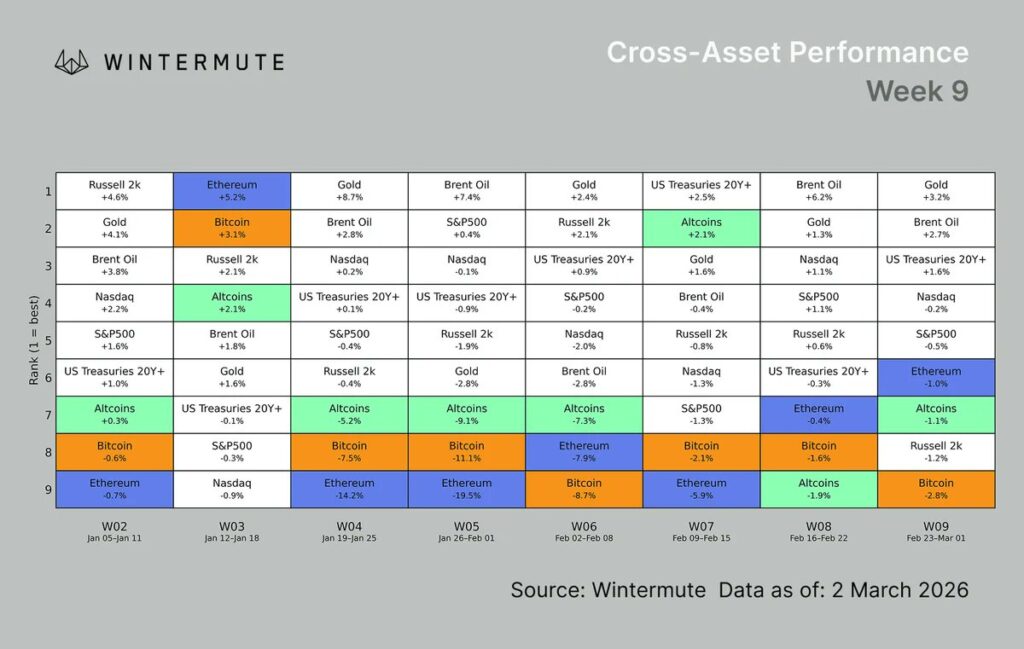
The daily swings today astonish many financial experts. Meanwhile, speculators are massively buying protective contracts against declines. Finally, alternative currencies are trying to find a lasting positive rebound. The vast majority of secondary tokens show rather disappointing results. In short, the absence of professionals weakens this entire financial ecosystem.
The virtual market is going through a very complex and uncertain period. However, current prices are already reflecting a lot of bad macroeconomic news. Bitcoin price has lost 45% since its all-time high. Speculators are quick to flee the sector during major downturns. Conversely, long-term holders are wise to hold onto their portfolios.
Looking to the future, analysts identify a very strategic shopping area. Priced between $40,000 and $50,000, the token is attracting the attention of experts. This level offers interesting profit potential for approximately eighteen months. In conclusion, moderation drives all strategies amid the current global crises.
Maximize your Cointribune experience with our “Read and Earn” program! Earn points for every article you read and get access to exclusive rewards. Register now and start reaping the benefits.

Journalist and web editor passionate about the world of cryptocurrencies and Web3 technologies. I focus on the latest trends and news in order to offer high quality content to a wide audience in the industry.
DISCLAIMER OF LIABILITY
The views, thoughts and opinions expressed in this article are solely those of the author and should not be taken as investment advice. Before making any investment decision, do your own research.