12:05 p.m
5
min read ▪ by
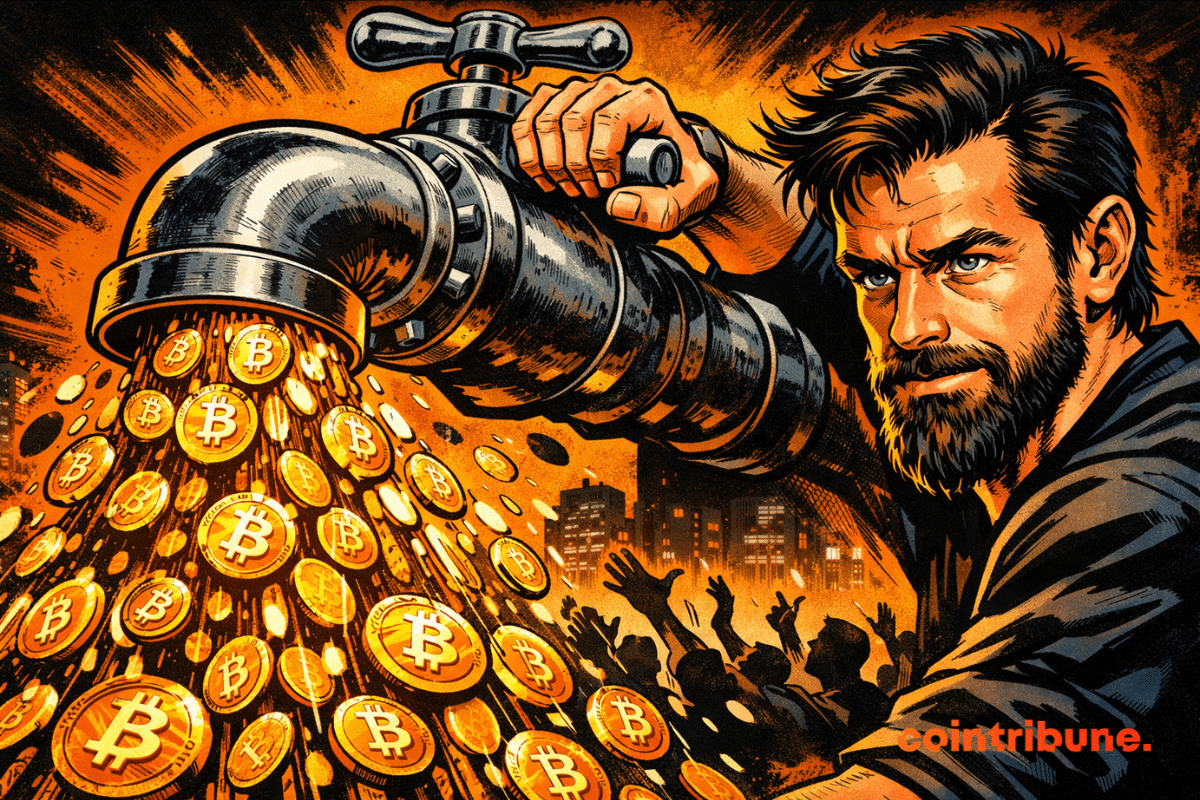
Accepting free bitcoins seems to belong to another era. However, this model could make a comeback. In the context of Bitcoin ETFs attracting institutional capital, an unexpected initiative is emerging again. Jack Dorsey Announces Return of Bitcoin Faucet. There is a broader strategy behind this clever idea. What if this forgotten mechanism became a key lever to revive the global adoption of Bitcoin?

In short
- Jack Dorsey is reviving the Bitcoin faucet concept, a historical model of getting free BTC.
- This initiative is part of a broader will to make Bitcoin accessible to a wider audience.
- Originally, faucets played a key role in the adoption of the network by distributing free bitcoins to early adopters.
- Today, their return could facilitate entry into the ecosystem and support a new phase of BTC adoption.
Jack Dorsey Brings Bitcoin Faucet Back Into Fashion
On Friday, Jack Dorsey, the former CEO of Twitter, revived a forgotten idea through a simple message published on X. In a few words, he mentions the return of the Bitcoin faucet, an emblematic concept from the network’s early days.
This announcement may be part of a broader strategy. For several years, he seemed to direct his initiatives towards a specific goal. Make Bitcoin a globally accessible tool.
With his company Block, he is already developing solutions aimed at the general public. In this context, the return of the faucet might seem like a logical extension of this approach.
This choice is also reminiscent of the early experiments of the Bitcoin network. In its early days, the free BTC distribution focused primarily on promoting exploration and understanding of the protocol.
Of course, this new faucet is unlikely to distribute 5 bitcoins per user. The context has changed profoundly. However, the principle would remain similar. Reproduce a model inspired by the origins of Bitcoin, adapted to the current reality.
The Bitcoin Faucet: From Inception to Strategic Return
Originally, the bitcoin faucet allowed to receive modest amounts of bitcoins for free. This system played a key role in the early days of the network. In fact, it made it easier to access a hitherto little-known technology.
The story goes back to 2010. Gavin Andresen, one of the first major Bitcoin developers, launches a brand new virtual faucet. His goal remains simple. Allow curious internet users to test this new digital currency without spending money.
The operation is surprising today. All you had to do was fill out a basic CAPTCHA to prove you were human. In exchange, the site gave away 5 free bitcoins. At the time, this amount was almost worthless.
Andresen used his resources to finance this initiative. He deposited around 1100 bitcoins which he mined himself. The original faucet worked for several years. She thus distributed tens of thousands of BTC all over the world.
In retrospect, these numbers seem staggering. Today, five bitcoins obtained in a few seconds would be worth several hundred thousand dollars. Eventually, the faucet gradually emptied. It closed when the price of Bitcoin started to rise.
So this model embodies the popular origins of Bitcoin. It is based on a simple idea. Make technology accessible to everyone without financial barriers.
Towards a New Phase of Bitcoin Acceptance?
The return of the Bitcoin faucet raises a key question. Could this help restart widespread BTC adoption?
On the one hand, the cryptocurrency market seems to be moving towards increased financial support. Derivatives and ETFs attract a growing share of traditional capital. On the contrary, the general public sometimes perceives direct access to this asset as complex.
In this context, the faucet could play a strategic role. It would offer a more efficient experience and help lower certain barriers to entry. The initial exposure to BTC could thus occur without an immediate financial commitment.
Moreover, this model could correspond to educational logic. It would explore the basics of the ecosystem in a hands-on way. This approach could gradually improve understanding and interest in the Bitcoin market.
This would give the faucet a new dimension. It would no longer serve only to discover this asset, but could become a gateway to a market that is already exposed to this global dynamic.
However, its impact would largely depend on its implementation. A modern faucet would have to meet current standards. It should offer a smooth and secure experience adapted to the current use. From this perspective, Bitcoin could continue to establish itself as central to the ongoing economic transformations.
Maximize your Cointribune experience with our “Read and Earn” program! Earn points for every article you read and get access to exclusive rewards. Register now and start reaping the benefits.

Journalist and web editor passionate about the world of cryptocurrencies and Web3 technologies. I focus on the latest trends and news in order to offer high quality content to a wide audience in the industry.
DISCLAIMER OF LIABILITY
The views, thoughts and opinions expressed in this article are solely those of the author and should not be construed as investment advice. Before making any investment decision, do your own research.