13:05 ▪
6
min read ▪ by
Public cryptocurrency mining companies are radically changing their financial strategy. In fact, they are massively selling their precious bitcoin reserves. Moreover, this new trend contrasts with the accumulation of the bull cycle. Today, miners face completely unprecedented economic challenges. As a result, they have liquidated over 15,000 BTC since October.

In short
- Publicly traded bitcoin mining companies have liquidated more than 15,000 BTC since October to shore up cash flow under pressure from declining profitability.
- The drop in the hash price below $30 makes mining much less profitable, forcing some players in the sector to sell their reserves to cover their costs.
- Large companies such as Core Scientific, Riot or MARA are adjusting their financial strategy and relaxing their bitcoin holding policy to maintain liquidity.
- Miners facing economic pressure are turning to artificial intelligence and data centers to diversify their revenue and improve margins.
Sharp decline in profitability for Bitcoin miners
The price of Bitcoin has been falling steadily for several months now. This unexpected drop seriously complicates the overall economics of mining. The hash price represents the true primary indicator of profitability. However, this vital indicator fell below thirty dollars. This level remains well below the companies’ operating costs.
In other words, many players are currently operating at a total loss. As a result, the gap between costs and revenues is widening. Historically, this momentum often triggers a massive selloff in digital assets. Current figures logically confirm this new complex financial reality. In addition, this bearish phenomenon significantly deepens the debt pressure.
Cash reserves are quickly disappearing with huge day-to-day operating costs
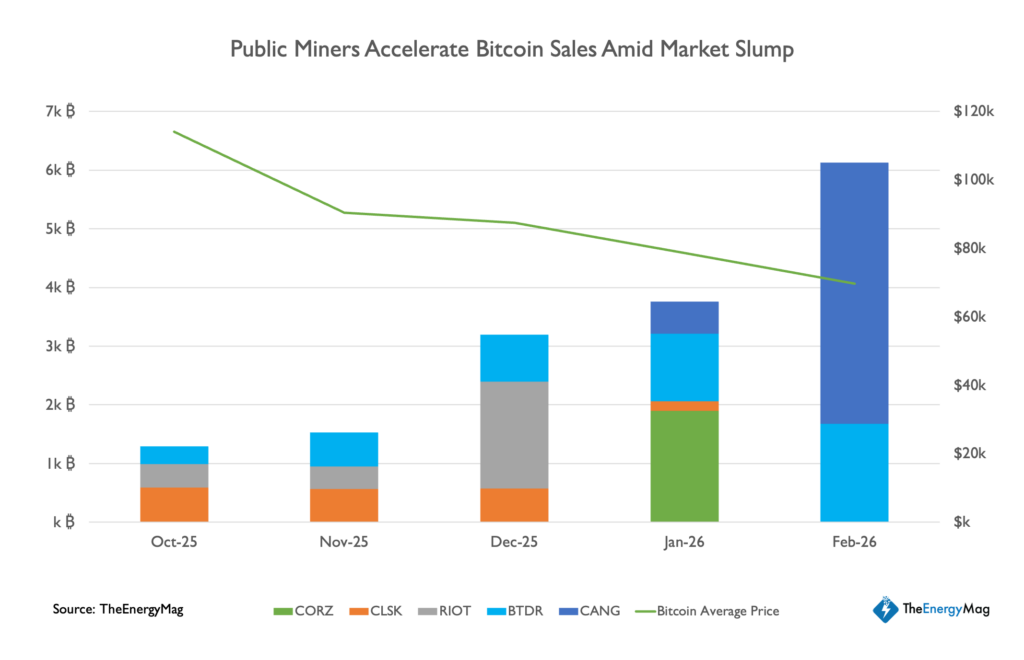
According to Miner Weekly, which publishes The Energy Mag, publicly traded miners have disposed of more than 15,000 Bitcoins since last October. Major mining companies in the sector are rapidly adapting their financial management. For example, Core Scientific plans to sell 2,500 BTC. In fact, the company already sold 1,900 units in January.
Riot, for its part, also expects very significant sales. In order for a company to function properly, it must absolutely maintain liquidity. This emergency measure ensures its daily working capital.
Even MARA is finally relaxing its coin holding policy. Of course, this huge company still holds over 53,000 Bitcoins. However, it now allows the sale of older tokens to survive. These unprecedented actions perfectly illustrate the intense pressure on the overall finances.
In addition, other sector players have already started liquidating a significant portion of their reserves. This is particularly the case with Cango, which sold 4,451 BTC in February, about 60% of its reserves, as well as Bitdeer, which reportedly liquidated all of its bitcoin cash holdings last month. These unprecedented actions perfectly illustrate the intense pressure on the overall finances.
Miners are turning to artificial intelligence to save digital mining margins
Faced with this economic disaster, a very attractive alternative is gradually emerging. Artificial intelligence and high-performance computing are now really attracting all the watchful eyes of Bitcoin miners. Financial arbitrage is becoming too powerful to be ignored indefinitely. A megawatt allocated to traditional mining yields less and less.
On the other hand, the same megawatt generates much more with AI servers. Sales can grow three to twenty-five times faster. As a result, strategic decisions are being made throughout the technology industry. For example, MARA signs a major deal with Starwood Capital. This global real estate giant manages 125 billion assets under management. The stated goal is to create data centers of the next generation. In addition, these new devices will actively support high-performance computing.
Industrial transformation financed by debt and mining
To finance this transformation, The Energy Mag reports in its article that miners are widely resorting to numerous loans. They regularly use credit lines and secured loans. In addition, they issue bonds to cover all their operations. New infrastructures designed for intensive computing are financed from these loans. On the one hand, companies are selling their cryptocurrencies to remain fully viable.
However, they are going into debt as they build their new technological future. This dual strategy clearly shows the absolute urgency of the current economic situation. Major players in the market are trying to diversify their sources of income. Ultimately, this complex transition requires absolutely massive and immediate capital.
Historically, the capitulation of producers very often means the end of crises. This financial purge usually cleans the excesses of the overall cryptocurrency market. However, the technology sector is still going through a period of very strong tension. Mining companies must absolutely stabilize their finances and invest massively at the same time. In the short term, selling pressure is very likely to remain intact. Diversification towards artificial intelligence, however, offers very promising prospects for the future.
This deep restructuring could permanently change the overall economic model of the industry. The survivors are most likely to become essential suppliers of computing power. This significant structural development ultimately redefines the role of technology players. In this way, the Bitcoin mining industry is likely to find truly sustainable financial stability.
Maximize your Cointribune experience with our “Read and Earn” program! Earn points for every article you read and get access to exclusive rewards. Register now and start reaping the benefits.

Journalist and web editor passionate about the world of cryptocurrencies and Web3 technologies. I focus on the latest trends and news in order to offer high quality content to a wide audience in the industry.
DISCLAIMER OF LIABILITY
The views, thoughts and opinions expressed in this article are solely those of the author and should not be taken as investment advice. Before making any investment decision, do your own research.