12:40 p.m
4
min read ▪ by
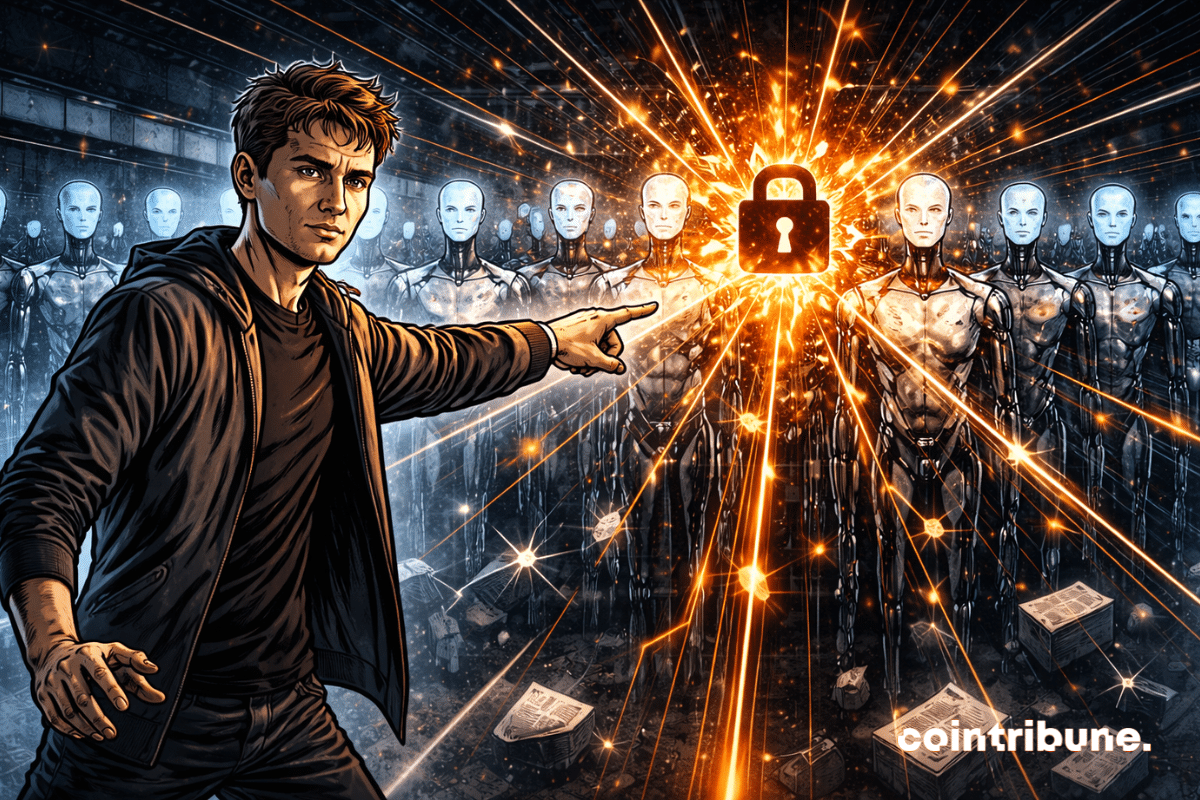
Artificial intelligence is moving fast, sometimes too fast for security. Vitalik Buterin warns of a worrying shift: intelligent agents are opening new vulnerabilities that are still poorly controlled. Faced with this risk, it breaks with dominant practices and chooses a radical approach based on local and decentralized artificial intelligence. The question behind this choice is: does innovation in artificial intelligence threaten recent gains in privacy and data control?
In short
- Vitalik Buterin warns of the growing risks associated with artificial intelligence agents, particularly their vulnerability to malicious instructions.
- A significant portion of the AI agent modules would be compromised, exposing users to invisible attacks and leakage of sensitive data.
- The co-founder of Ethereum questions the current cloud models, which are considered too permissive and insufficiently secure.
- It proposes an alternative architecture based on local, private and distributed AI to limit uncontrolled interactions.
And an underestimated threat in AI agents
Vitalik Buterin reveals structural vulnerabilities in the AI agent ecosystem. Data from security company Hiddenlayer suggests that nearly 15% of skills contain malicious instructions, a figure that raises questions about the reliability of these tools.
Several elements specifically illustrate this shift:
- A significant portion of agent modules integrating potentially hostile code;
- The ability of a simple malicious website to compromise an agent;
- An Openclaw case where an agent can download and run scripts without notifying the user;
- Lack of robust control mechanisms in many AI environments.
Buterin sums up these concerns in unequivocal terms: “I come from a deeply troubled mindset (…), we’re about to take ten steps back”. This statement reflects a common fear: regression in privacy.
Advances enabled by encryption and native software could be undermined by agents able to access, process, and transmit sensitive data without sufficient oversight.
A radical architecture for sovereign AI
Faced with these risks, Vitalik Buterin takes a radical technical approach. He abandoned cloud services to create the system he describes “sovereign/local/private/secure”. Its infrastructure relies on a locally run model combined with isolated environments through sandboxing tools. The goal is to drastically reduce uncontrolled interactions with the outside while maintaining complete control over the data.
At the heart of this system, Buterin introduces an unprecedented mechanism: “human + LLM 2 of 2” model. Any outgoing action to a third party, be it a message or an interaction, requires joint validation by the human and the AI. This logic extends to crypto usage. It recommends limiting automated transactions to $100 per day with mandatory validation outside or in the presence of sensitive data. according to him “AI agents should never have unrestricted access to wallets”a position that redefines security standards for blockchain-connected tools.
To complement this system, Buterin is exploring alternatives to classical remote inference. It mentions the use of technologies such as mixnets or secure execution environments to reduce data leaks. He also cites initiatives like ZK-API while acknowledging that some advanced solutions, such as fully homomorphic encryption, remain too slow for practical use.
The approach advocated by Vitalik Buterin outlines a possible evolution of AI towards more sovereign and distributed models. At the same time, it brings complex trade-offs between performance, availability and security. In a crypto ecosystem where automation and intelligent agents are gaining ground, these choices could influence the design of future wallets and protocols. This position does not close the debate; it moves to a central question: how far to delegate control to artificial intelligence without compromising the safety of users.
Maximize your Cointribune experience with our “Read and Earn” program! Earn points for every article you read and get access to exclusive rewards. Register now and start reaping the benefits.
A graduate of Sciences Po Toulouse and holder of the blockchain consultant certification issued by Alyra, I joined the Cointribune adventure in 2019. Convinced of the potential of blockchain to transform many sectors of the economy, I committed myself to raising awareness and informing the general public about this ever-evolving ecosystem. My goal is to enable everyone to better understand blockchain and take advantage of the opportunities it offers. I strive every day to provide an objective analysis of current events, decipher market trends, convey the latest technological innovations, and put into perspective the economic and social issues of this ongoing revolution.
DISCLAIMER OF LIABILITY
The views, thoughts and opinions expressed in this article are solely those of the author and should not be construed as investment advice. Before making any investment decision, do your own research.