21:35 ▪
4
min read ▪ by
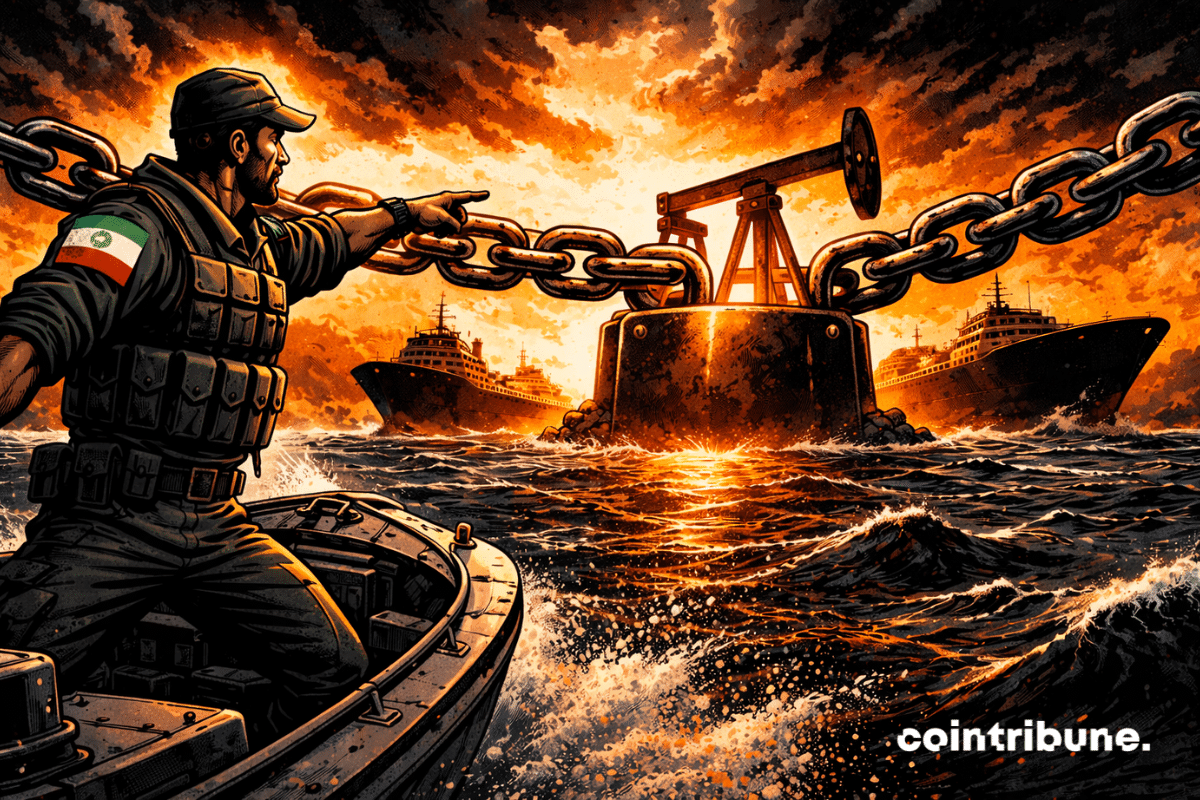
This Saturday, February 28, 2026 marks a major turning point in the escalation in the Middle East. Following US-Israeli airstrikes against the Iranian regime and its military capabilities, Tehran retaliated by effectively blocking the Strait of Hormuz. On the marine VHF waves, the Guardians of the Revolution broadcast a clear message: “No ship is allowed to pass. The major oil companies are already suspending their supplies. Will Brent break the symbolic $100 a barrel?”
In short
- Iran warns by radio that passage through the Strait of Hormuz is prohibited.
- Between 20 and 21 million barrels of oil, or 20% of global consumption, pass through this bottleneck every day.
- Oil companies are suspending their deliveries for security reasons.
- Markets expect a sharp rise in Brent prices right after Monday’s open.
Iran closes the Strait of Hormuz
On Saturday morning, the United States and Israel launch Operation “Epic Fury.” The strikes are aimed at Tehran, Isfahan and several strategic facilities. Florida’s Donald Trump calls on the Iranian people to “take back power.”
The choice of timing was not accidental: by striking on Saturday, Washington avoids an immediate reaction from Wall Street. Markets are closed. The shock is suppressed, at least temporarily.
The Iranian response was swift. The missiles are aimed at Israeli and American bases in Bahrain, Qatar and the United Arab Emirates. However, the strongest signal comes from the sea.
On VHF channel 16, the Iranian authorities announce a ban on passage through the Strait of Hormuz. The British Maritime Agency UKMTO and the European Maritime Mission confirm the warnings.
No official decree has yet been published. However, the effect is immediate. Tankers slow down, some remain in dock. Several trading houses and oil companies have stopped their operations for security reasons. This maritime corridor, only 33 kilometers long at its narrowest point, is becoming an area of extreme tension.
Iran has threatened to close Hormuz in the past. During the Iran-Iraq war in the 1980s, attacks on tankers drove oil prices up more than 50%. In 2019, sabotage has already burdened the markets. But never has the threat been so direct in the context of a direct confrontation with Washington.
Oil at the center of the economic storm
Why does this strait matter so much? It concentrates exports from Saudi Arabia, Iraq, the Emirates and Kuwait. Without it, more than 20% of the world’s oil will remain stranded. The only available bypass pipelines, Saudi Arabia and the Emirates, have a maximum capacity of 2.6 million barrels per day. Ridiculously undercapacity compared to the 20 million that normally flow through the strait.
By Friday evening, Brent had already closed at $72.87, up nearly 3% on the day and 8% on the month, driven by initial fears of an attack. On Monday, traders expect an upward gap of at least $5 to $10.
The darkest scenarios, mentioned by Barclays and Rystad Energy, talk about $100 if the chaos lasts for several days, some experts even say $150 in case of a longer escalation.
For the United States, the impact will be direct and painful. Gas station prices could rise 20 to 30 cents a gallon within weeks. Inflation, already evident, would rise again, putting the Fed in an impossible position: fight against rising prices or support an economy weakened by the shock.
Conversely, energy giants like Exxon or Chevron could see record profits… but at what cost?
All in all, this Saturday, February 28, 2026 will remain a pivotal date. Trump started the war with a careful choice of the weekend, but on Monday morning the markets will open and introduce the bill. The real test will not be played out in the skies over the Persian Gulf, but on the screens of Wall Street and at the pump of millions of Americans.
Maximize your Cointribune experience with our “Read and Earn” program! Earn points for every article you read and get access to exclusive rewards. Register now and start reaping the benefits.

I am passionate about Bitcoin, I love exploring the intricacies of blockchain and cryptocurrency and sharing my discoveries with the community. My dream is to live in a world where privacy and financial freedom are guaranteed for everyone, and I firmly believe that Bitcoin is the tool that can make this possible.
DISCLAIMER OF LIABILITY
The views, thoughts and opinions expressed in this article are solely those of the author and should not be taken as investment advice. Before making any investment decision, do your own research.