16:05 ▪
6
min read ▪ by
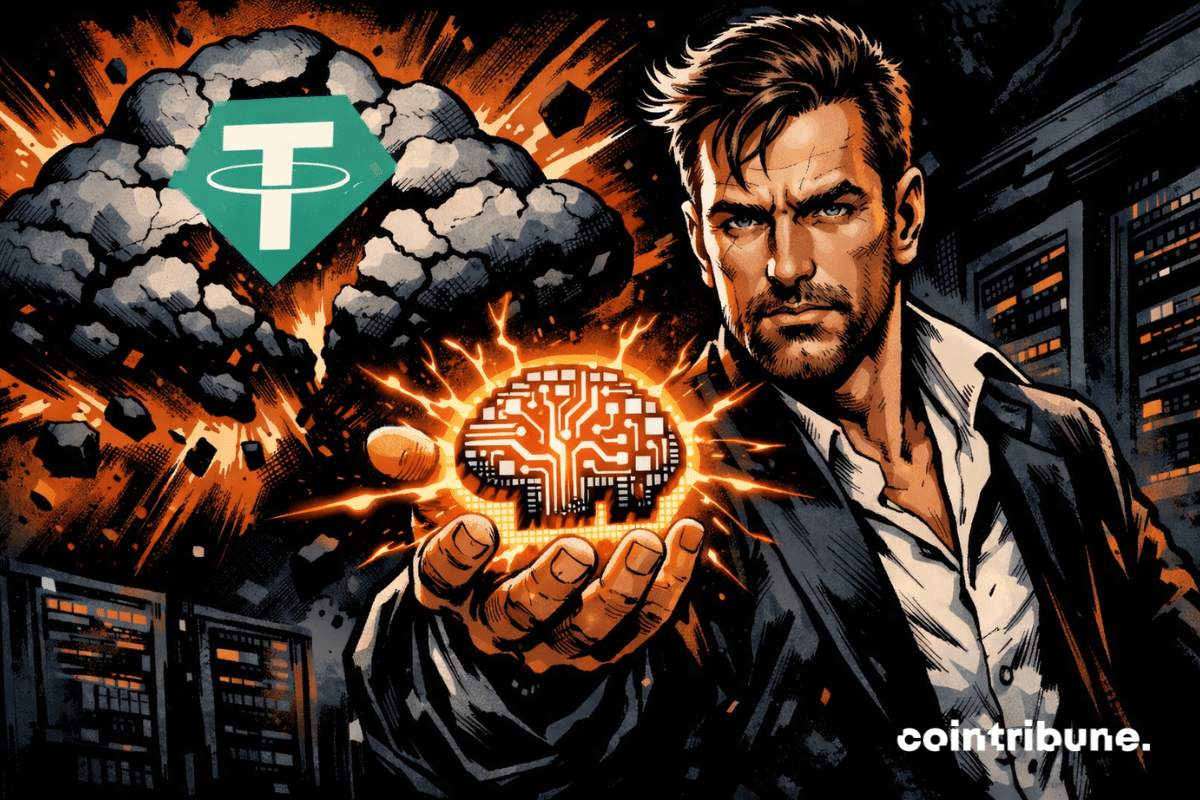
Paolo Ardoino, CEO of Tether, recently posted a short video on X. No title, no comment, no clue. Within minutes, the cryptosphere exploded. There was much more to this silence than just a show: a demonstration of the maturity of QVAC, the sovereign AI project that Tether has been quietly developing for several months.
In short
- Paolo Ardoino creates a buzz on X with a mysterious video before revealing the advanced capabilities of QVAC.
- QVAC offers local, private and autonomous artificial intelligence designed to put users back in control of their data.
- Between sovereign AI and stablecoin expansion, Tether is accelerating its global financial and technology infrastructure strategy.
QVAC, AI running in your pocket, away from Big Tech
The CEO of Tether, Paolo Ardoino, did not have to say more. A wordless video on X and theories quickly spread throughout the cryptosphere: a giant partnership, a new stablecoin, a surprise acquisition?
A few hours later, Ardoino breaks the silence with two consecutive tweets, a screenshot and then a link to qvac.tether.io. The mystery becomes clear. And reality trumps speculation.
What many took as a start was actually something else entirely. After nine months of discreet development, Arduino mainly wanted to show the true state of the QVAC, its current, concrete capabilities that are now available.
The project is no longer experimental. It’s mature, functional, and has a clear goal: to give users full control over their AI, their data, and their use.
So, what exactly is QVAC? Imagine an AI comparable to ChatGPT, but completely running on your phone or computer.
No cloud, no external API, no dependence on tech giants like OpenAI or Google. Everything stays stored locally: encrypted, private, under your control. Tether calls it “sovereign AI”. The idea sounds simple, but the technological disruption is profound.
Specifically, QVAC already allows you to:
- Chat with AI without data leaving the device;
- Analyze personal documents, contracts, notes or photos locally;
- Track your health data with QVAC Health without transferring to an external server;
- Translate and transcribe in real time with QVAC Translate (in deployment).
From May 2025 to February 2026, separate building
QVAC didn’t come out of nowhere. In May 2025, Tether officially announced a project with a clear ambition: to make AI as accessible and private as USDT was for digital currency.
Construction is going on brick by brick. In October 2025, QVAC Workbench, a cross-platform application for running AI models directly on consumer devices, was launched. It came up with Genesis I, the first synthetic dataset of 41 billion tokens focused on science and engineering.
In December, it debuted QVAC Health: a 100% local medical app with no commercial server involvement. Then, in January 2026, Genesis II increased the dataset to 148 billion tokens, now covering 19 academic disciplines, to improve the models’ reasoning.
On February 12, the first concrete samples appeared. A local AI assistant running in real time on a simple laptop. The pace quickened. And on February 25, two moments blew everything up.
First, the Blender demo: QVAC organizes a complete 3D pipeline through MCP, completely local, without a single data going to the server. Then QVAC-receive.
If you need an API key to use your AI, you don’t really own it. This sentence from Ardoino, uttered during the first announcement in May 2025, takes on full meaning today.
This placement sums up the whole philosophy of the project: local, independent AI controlled by the user. Additionally, QVAC Workbench and QVAC Health are already available for download on the official qvac.tether.io website, which is proof that the initiative has indeed entered its concrete phase.
An ecosystem that is growing rapidly
The company announces a strategic stake in the Whop platform, which distributes $3 billion annually to 18.4 million creators in 144 countries.
As part of the deal, Whop will integrate Tether’s WDK to offer payments in USDT and USAt, the recently launched “Made in America” stablecoin. The goal is simple: to anchor stablecoins where the money really flows, in markets where traditional banking systems remain slow, costly and often inaccessible.
And that’s not all. The meta plans to integrate stablecoins from the second half of 2026. For Tether, which already dominates the market with $183 billion USDT in circulation, or 62.4% of the global total, this is a window for massive adoption. Society cannot withstand this wave. It positioned itself to abduct him.
Having made the digital dollar accessible to hundreds of millions of people, Tether is now tackling artificial intelligence with the same philosophy: to make it private, sovereign and truly in the hands of its users. In a world where tech giants live off your data, QVAC represents a bet as ambitious as it is daring. And Paolo Ardoino doesn’t seem to surprise us.
Maximize your Cointribune experience with our “Read and Earn” program! Earn points for every article you read and get access to exclusive rewards. Register now and start reaping the benefits.
I am passionate about Bitcoin, I love exploring the intricacies of blockchain and cryptocurrency and sharing my discoveries with the community. My dream is to live in a world where privacy and financial freedom are guaranteed for everyone, and I firmly believe that Bitcoin is the tool that can make this possible.
DISCLAIMER OF LIABILITY
The views, thoughts and opinions expressed in this article are solely those of the author and should not be taken as investment advice. Before making any investment decision, do your own research.