
11:05 AM ▪
4
min read ▪ by
While the crypto market remains hesitant, Ethereum is sending an unexpected signal behind the scenes. Behind the apparent phase of stagnation, some indicators show a development in the behavior of investors. While institutional flows are slowing, the derivatives market is revealing a different dynamic. This contradiction raises a central question: is the queen of altcoins preparing a subtle turnaround?

In short
- The Ethereum derivatives market is showing the return of buying pressure after a long phase dominated by sellers.
- Net taker volume is returning to positive values, a signal rarely seen in several years.
- Ethereum ETFs have seen a steady outflow of capital, reflecting a decline in institutional interest.
- The divergence between derivatives and the spot market creates an uncertain dynamic, but opens the way for a possible reversal.
Ethereum derivatives confirm market reversal
First, an analysis of Ethereum on-chain data reveals a progressive shift in the derivatives market. While selling pressure has dominated for several months, buyers are now regaining the upper hand. This change mainly concerns the development of net subscriber volume, a key indicator for measuring the dominance of buyers or sellers on Ethereum derivatives.
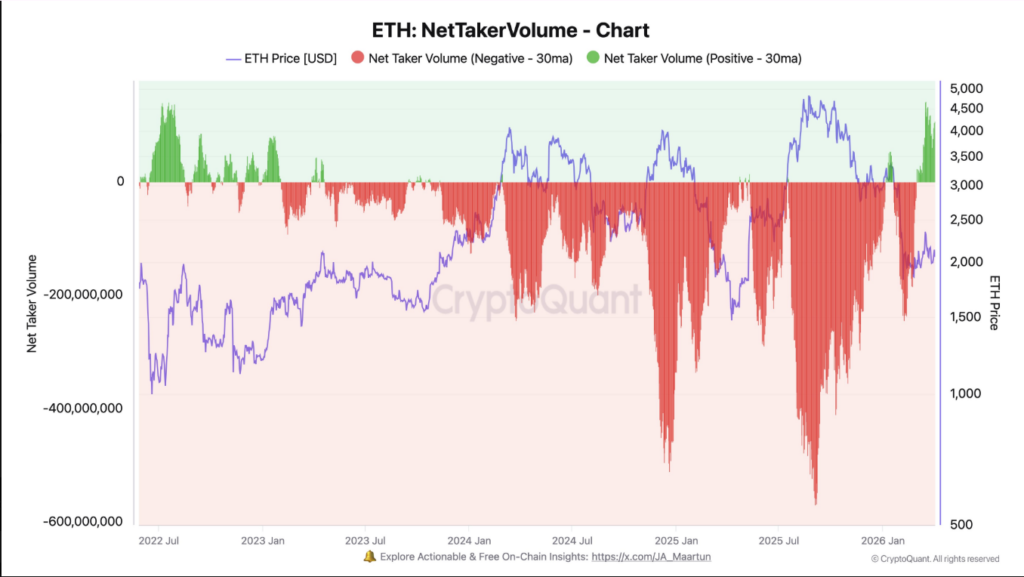
According to data shared by analyst Darkfost, net buying volume on Ethereum will turn positive again, confirming the return of buying pressure on derivatives, a rare signal that attracts attention after a bearish phase.
- Net buyer volume exceeds buyer surplus by $104 million.
- Ethereum price hovered around $2,058 for 1 month with a 0.6% increase in 24 hours.
- Buying dominance is emerging for the first time in three years, marking a regime change in derivatives.
- The market is starting a gradual transition to a more constructive dynamic.
Thus, these signals reflect progressive developments where positions are adjusted without accurate validation from the spot market.
ETFs under pressure: capital outflows persist
At the same time, Ethereum ETFs continue to send the opposite signal. US exchange-traded funds saw capital outflows for the third week in a row.
Last week, these products suffered more than $42 million in withdrawals. In addition, a single day concentrated more than $71 million in outflows across all crypto products.
Thus, this trend reflects a decline in the appetite of institutional investors. It is in direct contrast to the renewed activity seen in Ethereum derivatives. Furthermore, this divergence between derivatives and the spot market creates uncertainty about the reliability of the current signal.
A positive sign, but still a fragile balance for Ethereum
Despite ETF pressure, the derivatives market is showing signs of development. This return of buying pressure could help stabilize the price and create a floor.
Indeed, the continued dominance of derivatives buyers may preempt a broader market recovery. However, this scenario will depend heavily on the behavior of investors in the spot market.
Additionally, Ethereum is currently evolving in a phase of balance between positive signals and external pressures. On the one hand, derivatives indicate renewed interest. On the other hand, ETFs continue to influence overall sentiment.
So if ETF flows reverse and support this momentum, Ethereum could once again regain a more favorable structure. Conversely, a lack of confirmation would limit the impact of this signal. However, the following weeks will be decisive. Without spot market support, this recovery could remain limited in a context marked by the rise of ETH bets.
Maximize your Cointribune experience with our “Read and Earn” program! Earn points for every article you read and get access to exclusive rewards. Register now and start reaping the benefits.

Journalist and web editor passionate about the world of cryptocurrencies and Web3 technologies. I focus on the latest trends and news in order to offer high quality content to a wide audience in the industry.
DISCLAIMER OF LIABILITY
The views, thoughts and opinions expressed in this article are solely those of the author and should not be taken as investment advice. Before making any investment decision, do your own research.