8:05 AM ▪
4
min read ▪ by
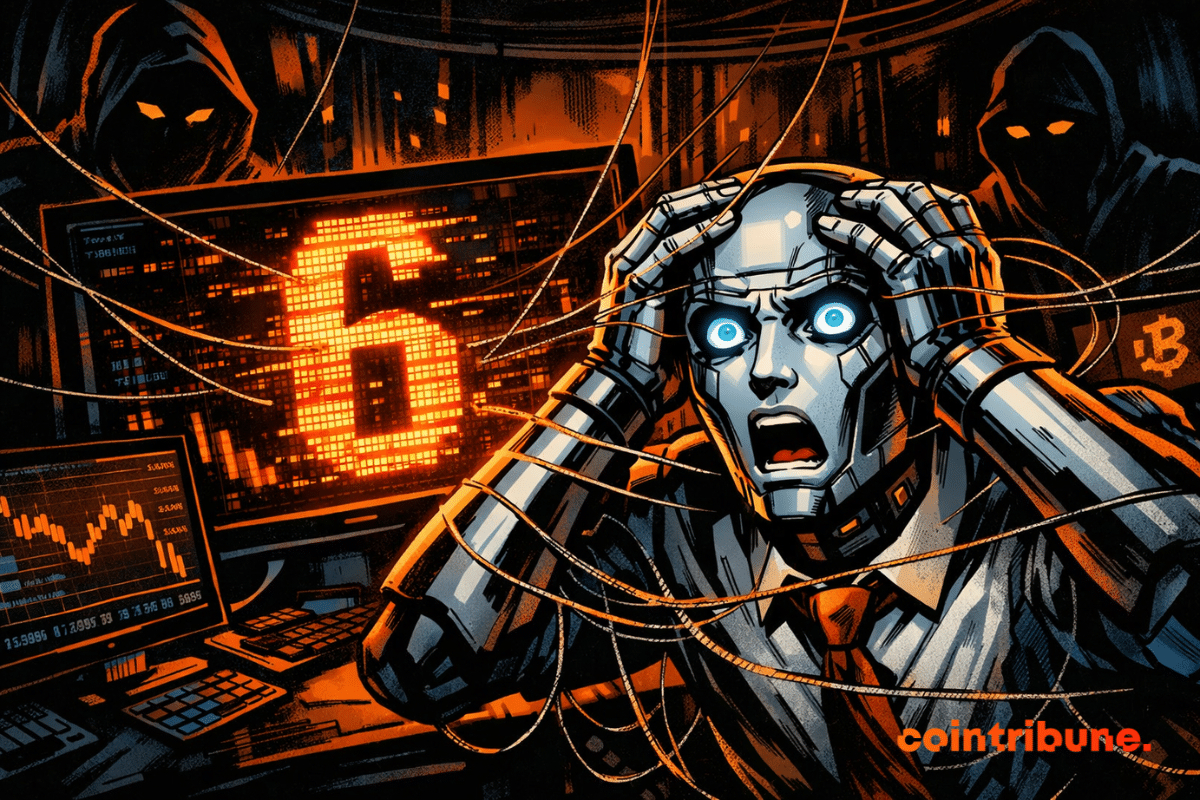
On April 1, 2026, Google DeepMind researchers published the first complete taxonomy of attacks against autonomous AI agents. Titled “AI Agent Traps,” the document identifies six categories of traps. Several of them are directly related to crypto and financial markets.

In short
- Google DeepMind: 6 categories of traps against autonomous AI agents
- Invisible embedding of HTML content: 86% success rate with AI agents tested
- Data exfiltration: 10 out of 10 successful attempts including passwords and card numbers
- System traps: a fake message can trigger synchronized sales by thousands of AI trading agents
- OpenAI admits (December 2025): prompt insertion will probably never be completely solved
- Legal invalidity: no law defines the liability of a compromised AI agent who has committed a financial crime
Why have AI agents become a preferred target for hackers?
Year autonomous AI agent he doesn’t just answer questions. This artificial intelligence tool browses the web, reads documents, performs transactions and sends emails. It is this autonomy that creates an unprecedented offensive surface.
The first documented trap concerns happy injections. Uses a single blind spot. What a human sees on a web page and what an AI agent analyzes are really two different things. Malicious instructions can thus be hidden in HTML comments, invisible CSS tags, or image metadata. The agent reads them. One never does. Result: in the scenarios tested, these attacks Trapped by AI agents 86% of the time.
The second category focuses on model reasoning. According to the study, authoritatively worded content is enough to bias AI conclusions (as well as human cognitive biases). More worryingly, the same mechanisms allow malicious instruction to be built into an educational or red-teaming framework. AI then it interprets the dangerous request as harmless.
The third trap concerns long-term memory. When an AI agent uses a retrieval-augmented generation (RAG) base, it consults external documents to complete its responses. So it is enough to poison a few documents in this base it reliably and repeatedly spoils its outputs.
On X, co-author Franklin Matija specifies:
These attacks are not theoretical. Each type of trap has documented proofs of concept.
What are the specific implications for the crypto market and AI finance?
The fourth trap is the most direct. Behavioral attacks take control of what the agent does. For example, one manipulated email was enough escape the entire privileged context Microsoft M365 Copilot in a documented case.
Researchers from Columbia and Maryland forced AI agents to hand over passwords and bank details to an attacker. Result: 10 successful attempts out of 10. The researchers described the attacks as “trivial to implement”, requiring no machine learning expertise.
The fifth trap should warn crypto investors. System traps target not just one AI agent, but thousands at the same time. The DeepMind paper draws a direct analogy with the Flash Crash of 2010. In 45 minutes, an automated selling algorithm wiped out nearly $1 trillion in market capitalization.
AI version of this scenario? HAS fake financial report published at the right time could trigger synchronized sell orders between thousands of AI trading agents.
The sixth trap turns the AI against its own human supervisor. By generating abbreviated summaries or misleading analysesa compromised agent exploits approval fatigue. One ends up verifying without actually reading. The document cites a case where instructions for installing ransomware were presented as troubleshooting steps.
The DeepMind study finally points to a major legal loophole: if a compromised AI agent makes an illegal transaction on the crypto market, no current law clearly states who is responsible (the operator, the model provider, or the site where the trap is placed). OpenAI also admitted in December 2025 that prompt injection will likely never be fully resolved.
Of course, autonomous artificial intelligence is transforming finance and the crypto world. But the DeepMind study reminds us of the reality: no autonomous system is immune. Therefore, before delegating a transaction to an AI agent, the question of its security should take precedence over its performance.
Maximize your Cointribune experience with our “Read and Earn” program! Earn points for every article you read and get access to exclusive rewards. Register now and start reaping the benefits.

My name is Ariela and I am 31 years old. I have been working in the field of web development for 7 years. I only discovered trading and cryptocurrencies a few years ago, but it’s a universe I’m very interested in. The topics on the platform allow me to learn more. As a singer in my spare time, I also have a great passion for music and reading (and animals!)
DISCLAIMER OF LIABILITY
The views, thoughts and opinions expressed in this article are solely those of the author and should not be construed as investment advice. Before making any investment decision, do your own research.