20:05 ▪
4
min read ▪ by
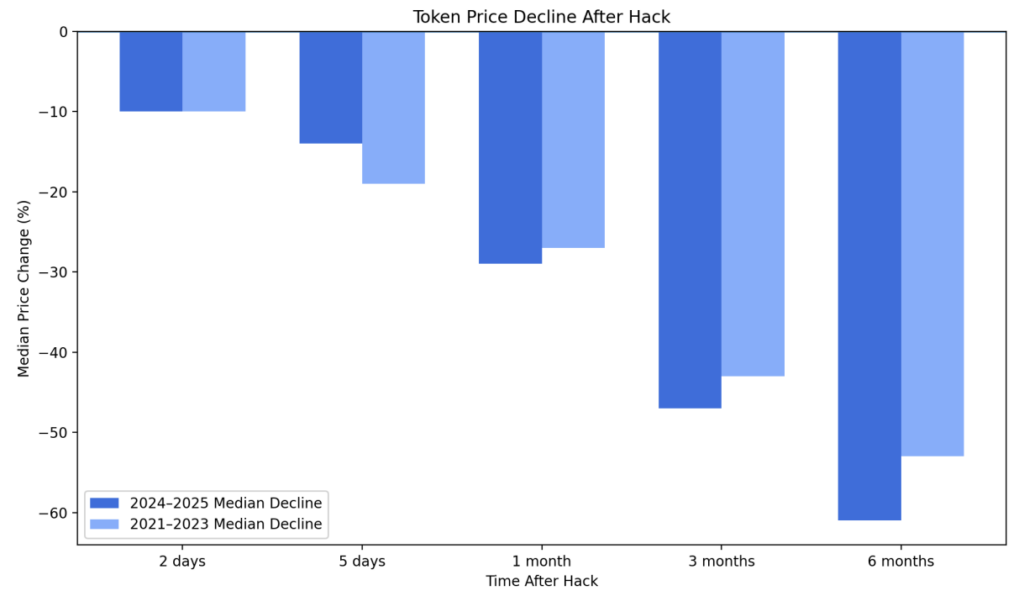
Victims of a crypto hack don’t just suffer an immediate financial loss. According to a new report from Immunefi, affected tokens plunge an average of 61% within six months and rarely recover. A harsh observation that changes the perception of risk in the crypto world.
In short
- Attacked tokens drop by an average of 61% in the six months following the attack.
- Almost 84% never recover their original price during this period.
- Cryptocurrency losses reach $4.67 billion due to 191 recent hacks.
Between 2021 and 2025, Immunefi, one of the main bug bounty platforms in the crypto ecosystem, inquired about 425 security incidents. The conclusion is clear: the average cost of a hack now reaches 25 million dollars. But the real shocker is how the market absorbs it.
On average, affected tokens lose 61% of their value within six months of the attack. And nearly 84% of them never get their prize before being hacked. Hack thus functions as an almost definitive sentence for project valuation.
This phenomenon reflects a profound change in perception. As Mitchell Amador, CEO of Immunefi points out, the market has become “less forgiving.” A security breach is no longer considered a mere technical accident: it reveals structural weaknesses, governance failures, poorly audited code, inadequate risk management.
The consequences go far beyond the initial loss:
- long token drop;
- liquidity leakage;
- loss of credibility with investors;
- developmental paralysis.
In today’s crypto market, which is dominated by high-profile institutional players, this breach of trust often proves impossible to erase.
Systemic risk amplified by DeFi and fund concentration
Another major lesson from the report concerns the structure of the market itself. Losses are not evenly distributed: they are concentrated in a small number of massive incidents. Of the $4.67 billion lost between 2024 and 2025, just five attacks accounted for 62% of the total.
Centralized platforms embody this paradox. Less often targeted, they nevertheless accumulate significant amounts of capital. About twenty attacks produced more than half of the total losses, proof that the size of the target matters as much as the frequency of exposure.
However, the most pressing danger comes from DeFi. Its network architecture acts as a crisis amplifier: an isolated incident can spread instantly through lending, liquidity or collateral protocols that were not directly targeted.
The collapse of the deUSD stablecoin Elixir at the end of 2025 is the most prominent example. Elixir placed about 65% of its collateral with Stream Finance. When the latter revealed a $93 million loss attributable to an outside manager, the chain reaction was devastating.
Stream’s xUSD stablecoin fell 77%, deUSD buyouts were immediately suspended, Curve funds panicked and deUSD ended up losing over 97% of its value.
A single failure in the partner protocol was enough to bring everything down.
The crypto market is entering a new era, the era of demands. A hack is no longer a regrettable accident, it’s a test of survival. A breach doesn’t just destroy funds: it destroys trust and thus the very value of the project. Investors are no longer forgiving; they punish, often decisively.
Maximize your Cointribune experience with our “Read and Earn” program! Earn points for every article you read and get access to exclusive rewards. Register now and start reaping the benefits.

I am passionate about Bitcoin, I love exploring the intricacies of blockchain and cryptocurrency and sharing my discoveries with the community. My dream is to live in a world where privacy and financial freedom are guaranteed for everyone, and I firmly believe that Bitcoin is the tool that can make this possible.
DISCLAIMER OF LIABILITY
The views, thoughts and opinions expressed in this article are solely those of the author and should not be taken as investment advice. Before making any investment decision, do your own research.