
17:25 ▪
3
min read ▪ by
Stablecoins, these cryptocurrencies tied to stable assets, are experiencing rapid growth. With a market estimated at $300 billion, their massive adoption is worrying the European Central Bank (ECB). Why are these digital assets a danger to Europe and the euro?

In short
- The ECB is concerned about the rise of stablecoins, which could weaken the EURO and reduce the ability of banks to finance the European economy.
- Regulations such as MiCAR in Europe and the Genius Act in the United States aim to regulate these cryptocurrencies to maintain financial stability.
- A digital euro project in development could offer a secure alternative to private stablecoins while protecting bank deposits.
Europe: ECB considers stablecoins a threat to the euro
Stablecoins, often backed by the US dollar, could weaken the euro’s position in the markets. According to the ECB, their growing adoption threatens European monetary sovereignty, as more than 95% of these assets are denominated in dollars. Therefore, a massive migration of bank deposits to stablecoins could reduce the ability of banks to finance the real economy.
The numbers speak for themselves. Indeed, bank deposits in the eurozone amount to 17 trillion euros. If a significant portion of these funds were transferred to stablecoins, banks could lose a major source of funding. At an estimated $300 billion, the ECB fears that stablecoins, if dominated by non-euro-denominated instruments, could further weaken the single currency’s position.
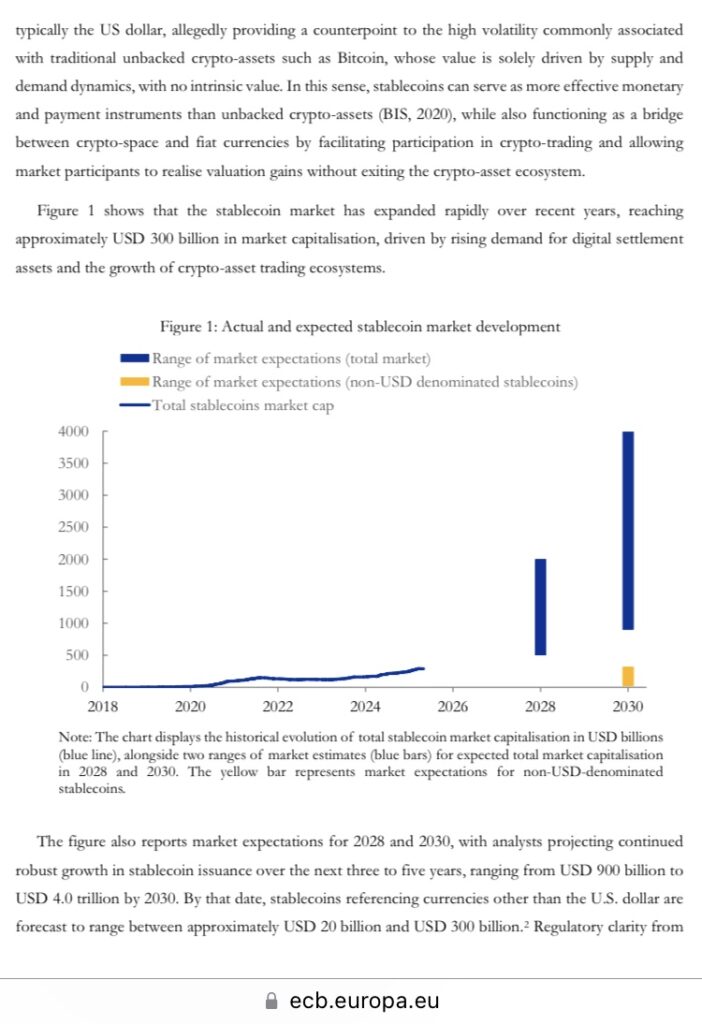
Finally, stablecoins offer fast and cheap transactions that attract more and more users. However, their dependence on the dollar poses a major challenge to European monetary policy, which could lose effectiveness against foreign digital currency, according to a recent ECB paper.
Crypto: what rules to supervise stablecoins and protect the euro?
Faced with the risks posed by stablecoins, Europe proposed the MiCAR regulation, which imposes strict limits on electronic money-denominated assets. This regulatory framework aims to preserve financial stability while enabling innovation. In the United States, the Genius Act proposes a similar approach, requiring stablecoins to be backed by liquid assets such as the dollar.
The ECB is also working on a digital euro project, a dematerialized version of the European currency. This project, which is still under development, could offer a secure alternative to private stablecoins like Tether. The aim of the digital euro is to protect bank deposits and strengthen monetary sovereignty in the eurozone with per-person limits.
Stablecoins raise big questions about the future of monetary sovereignty in Europe. Between financial innovation and systemic risks, their growth is forcing regulators to act. The ECB with a digital euro must strike a balance between regulation and freedom to preserve the stability of the euro. Do you think stablecoins are a revolution or a threat to the European economy?
Maximize your Cointribune experience with our “Read and Earn” program! Earn points for every article you read and get access to exclusive rewards. Register now and start reaping the benefits.

The world is evolving and adaptation is the best weapon to survive in this wavy universe. Originally a manager of the crypto community, I am interested in anything directly or indirectly related to blockchain and its derivatives. In order to share my experiences and promote a field that I am passionate about, there is nothing better than writing informative and relaxed articles.
DISCLAIMER OF LIABILITY
The views, thoughts and opinions expressed in this article are solely those of the author and should not be taken as investment advice. Before making any investment decision, do your own research.