
18:05 ▪
4
min read ▪ by
Bitcoin is increasingly moving from private portfolios to public balance sheets. A new report from River suggests that governments are no longer passive observers of the market. Today, 23 countries hold BTC in some capacity, meaning a meaningful expansion of state-level participation.

In short
- Governments collectively hold 432,000 BTC, which equates to 2.1% of the total supply.
- The United States leads the sovereign Bitcoin with 328,372 BTC.
- Mining power is spread around the world, reducing the previous risks of concentration.
- Thirty-four countries have approved Bitcoin ETF or ETP products.
The United States leads global sovereign bitcoin holdings at 328,372 BTC
According to Rivera, these holdings come from asset seizures, outright purchases, state-backed mining operations and the allocation of state wealth. The government’s exposure now spans North America, Europe, the Middle East, Asia, Africa and Latin America – a sign that bitcoin adoption has reached multiple layers of government infrastructure.
The United States has the largest sovereign position with 328,372 BTC, primarily accumulated through criminal asset confiscations. Meanwhile, the United Kingdom follows with 61,245 BTC. UAE holds 30,382 BTC through sovereign wealth and mining strategies. China, despite banning domestic mining, is estimated to control 15,000 BTC from earlier seizures.
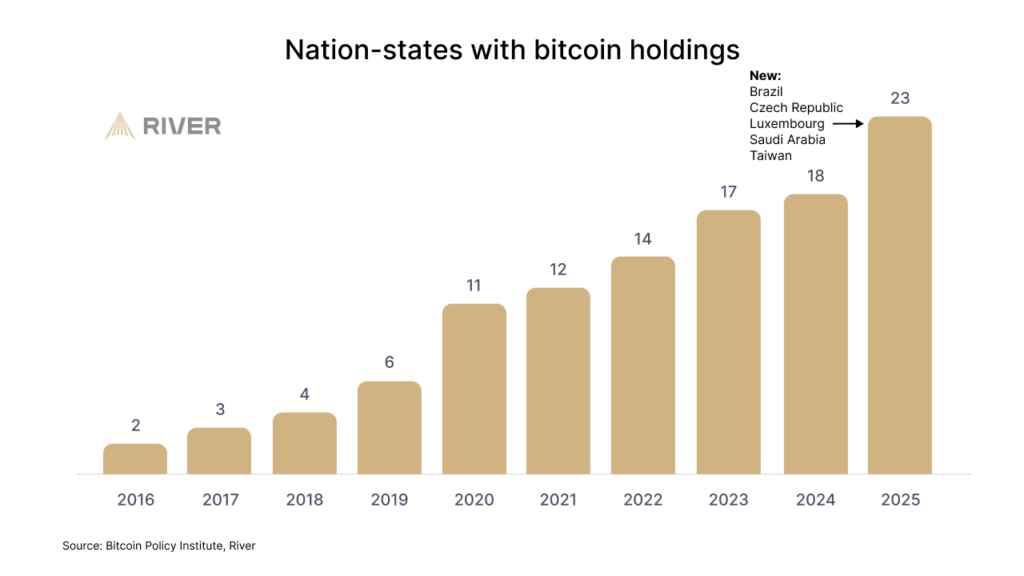
El Salvador remains the only country to designate Bitcoin as legal tender, with government reserves totaling 7,514 BTC acquired through open market purchases. Bhutan holds 5,884 BTC tied to a state-backed mining operation, illustrating how smaller economies are experimenting with alternative accumulation strategies.
Nation states control 2.1% of BTC supply as mining power expands globally
As of December 31, 2025, governments collectively hold approximately 432,000 BTC – about 2.1% of the total supply. Individuals remain the dominant holders, controlling 14.01 million BTC, or 66.7% of the circulating supply. Funds and ETFs account for 1.49 million BTC, while businesses hold 1.45 million BTC. Retail ownership continues to anchor the market even as institutional and sovereign exposures expand.
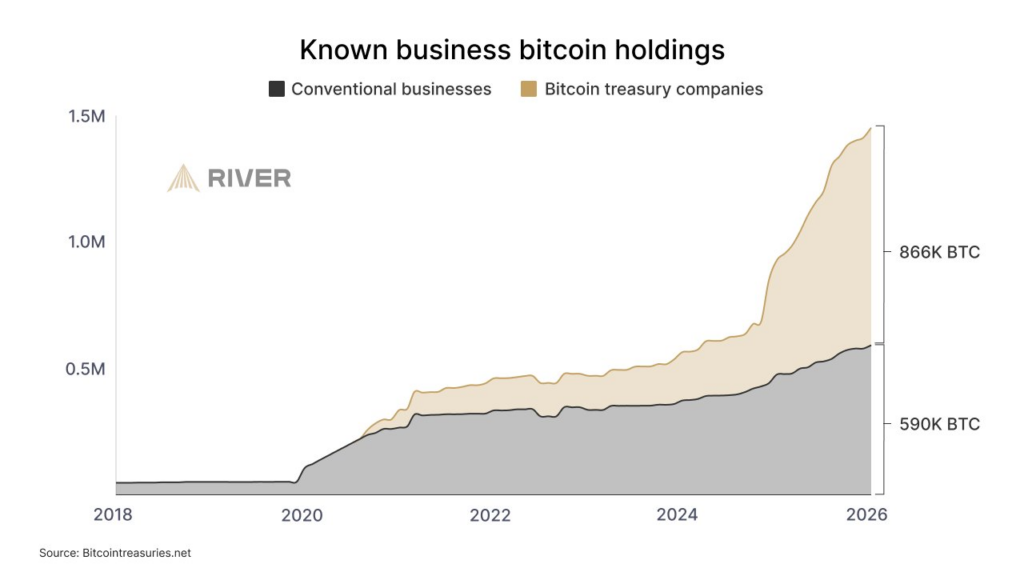
Meanwhile, River reports that 34 countries now control more than 0.1% of the global hashrate, while 12 countries exceed 1%. Compared to previous cycles, mining activity is significantly more geographically dispersed, reducing the concentration risk once associated with a small number of jurisdictions.
Several structural forces drive sovereign engagement:
- Asset forfeiture serves as the primary entry mechanism that transfers bitcoins directly into government custody.
- State-backed mining provides exposure without the need for open market purchases.
- Sovereign wealth funds gain indirect exposure through equities, ETFs and structured products.
- Legal recognition like El Salvador’s framework integrates bitcoin into fiscal policy and public finance planning.
In addition to governments, the participation of institutions continues to expand. Hedge funds, asset managers, pension funds, endowments, insurance companies and sovereign wealth vehicles report rising allocations. Billions of dollars in bitcoin exposure now sit in traditional financial frameworks.
34 Countries Approve Bitcoin ETFs as Global Regulation Becomes Supportive
In 2025, North America saw 6,535 merchants accepting Bitcoin, up 1,299 from the previous year. Europe leads slightly with 6,745 traders. Activity on the Lightning Network has increased, with River estimating a 300% increase in transaction volume over the year. Exchange integrations for Lightning deposits and withdrawals contributed to higher average transaction sizes.
Regulatory developments further support adoption. 34 countries have approved Bitcoin ETFs or ETPs. Others have legalized mining, clarified tax treatment, or empowered banks to provide escrow services. These measures create clearer channels for institutional and sovereign capital participation.
Introduced in the wake of the 2008 financial crisis, Bitcoin was originally conceived as an alternative to state-controlled monetary systems. Seventeen years later, it is increasingly held by these states. What began as a decentralized experiment now occupies the balance sheets of 23 governments—a shift that marks a new phase in bitcoin’s structural evolution.
Maximize your Cointribune experience with our “Read and Earn” program! Earn points for every article you read and get access to exclusive rewards. Register now and start reaping the benefits.

James Godstime is a crypto journalist and market analyst with over three years of experience in crypto, Web3 and finance. Simplifies complex and technical ideas to engage the reader. Outside of work, he likes football and tennis, which he is passionate about.
DISCLAIMER OF LIABILITY
The views, thoughts and opinions expressed in this article are solely those of the author and should not be taken as investment advice. Before making any investment decision, do your own research.